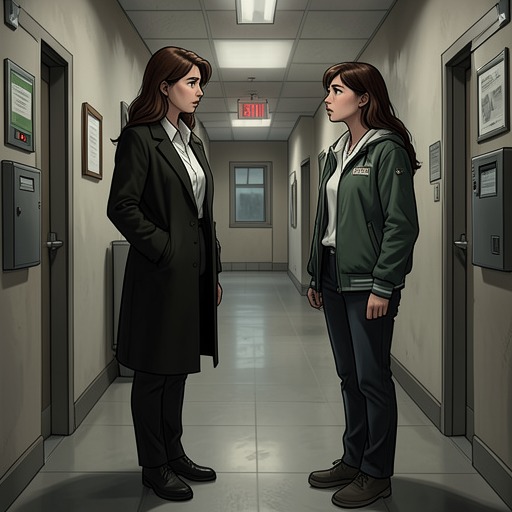
Hadley and Ms. Pitt return to their own bodies
Freaky FridayHadley and Ms. Pitt return to their own bodies at the cafeteria dance, bringing the central bodily reversal to its long-awaited resolution. The change follows a shared recognition of the lesson in To Kill a Mockingbird: understanding another person requires considering life from that person’s point of view. A sudden blackout interrupts their exchange, and when the lights return, each recognizes that she is herself again. Their relief transforms the resolution from a mere restoration of appearances into evidence of the perspective-taking the experience has taught them.
Recognition Through the Book’s Lesson
Hadley asks Ms. Pitt to recall what they had discussed earlier that morning, then clarifies that she means the passage from To Kill a Mockingbird about seeing from another person’s perspective. The conversation makes the novel’s lesson the immediate context for the return: the body swap has made perspective-taking more than a school assignment. Hadley recognizes that she had read the book and studied its vocabulary without fully absorbing its meaning, whereas the day’s experience has allowed her to understand it differently.
Hadley begins reciting the passage about considering things from another person’s point of view. Ms. Pitt supplies the next fragment, and they finish the sentence together, including its image of climbing into another person’s skin and walking around in it. Their synchronized recollection links the lesson’s figurative language to the literal bodily experience they have shared. It also shows that, by the moment of reversal, the two are interpreting the experience together rather than speaking from isolated perspectives.
The Reversal at the Dance
As Hadley and Ms. Pitt finish the quotation, the cafeteria lights crash and spark, briefly plunging the room into darkness. Students scream; within moments the lights resume, and students seek reassurance by hugging one another. The return to normal lighting reveals the decisive change for the two women: as Hadley speaks, she hears her own voice rather than Ms. Pitt’s. The unexpected electrical interruption is the scene’s turning point, separating their shared realization from the recognition that their bodies have changed back.
Ms. Pitt responds with a delighted squeal and checks that her own body has returned. Hadley’s reaction is equally immediate: she celebrates being back in her teenage body, describing relief as flooding through her. Neither has to infer the outcome from the other’s appearance alone; each recognizes the restoration in herself. The exchange establishes that the swap has ended and that both have regained their original bodies.
Relief and Renewed Relationship
The return produces an exuberant release after the strain and disorientation of the day. Hadley and Ms. Pitt link arms and twirl around the room, laughing as the accumulated insanity and relief take hold. The scene briefly makes their happiness public: someone calls out from the sidelines for them to save their embrace for a slow dance, and the laughter spreads to the two of them as well. The reversal therefore ends not in distance but in open, mutual celebration.
Hadley then looks at Ms. Pitt and recognizes that she is seeing her teacher’s face rather than her own. She clings to Ms. Pitt, overcome with tears and laughter, and says she has never been so happy to see her. The importance of this gesture lies in the contrast with their earlier bodily confusion: returning to separate bodies does not undo the closeness formed through inhabiting each other’s perspective. The restoration resolves the physical predicament while leaving their newly deepened understanding intact.
Significance
The scene makes the body swap’s conclusion inseparable from its lesson in empathy. Hadley’s understanding of To Kill a Mockingbird changes because she has experienced a different perspective, and her shared completion of its central quotation with Ms. Pitt immediately precedes the return. The narrative thus places recognition before physical restoration: they articulate what the experience has taught them, then discover that their bodies are their own again.
The cafeteria’s brief darkness gives the reversal a clear dramatic threshold, while the returning lights enable Hadley and Ms. Pitt to recognize the change. Their relief, laughter, embrace, and recognition of one another’s faces establish the outcome as more than a reset. They regain their individual bodies, but the perspective-taking that made the ending possible remains the scene’s defining consequence.